
Quartz & Industrial Minerals for B2B Supply

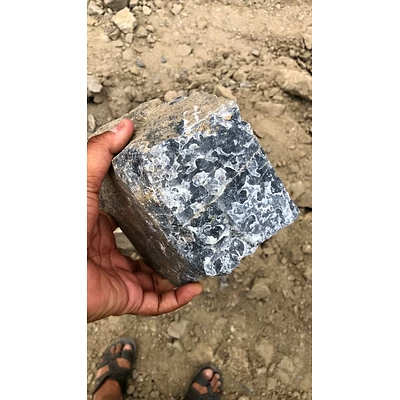
Grey Quartz Lumps for Industrial Processing and Material Supply
grey quartz lumps for milling & filler production
Plastics and glass manufacturers source grey quartz lumps as feedstock for milling and blending operations. Lumps provide a coarse starting material for controlled grinding to target particle-size distributions used in glass and filler formulations. Request current MOQ and lead time to align material deliveries with grinding schedules and batch processing.
Material & Size Specifications
- Typical lump size distribution: 8–40 mm suitable for primary crushing and mill feed.
- Bulk density typically ~2.6–2.7 g/cm³ depending on mineral composition.
- Silica content typically high; perform silica assay to confirm specification for glass grades.
- Impurities such as iron oxide typically <1% for higher-grade industrial supplies.
Bulk Supply & Logistics Terms
- MOQ: Minimum order quantity depends on fraction and container load; request current MOQ for processing volumes.
- Lead Time: Lead time varies with sizing and container preparation; request current lead time for your batch requirements.
- Supply Capacity: Coordinated with plant-side capacity to support recurring orders and scheduled runs.
- Packaging: Jumbo bags or loose container-loads per buyer handling needs.
- Quality Check: Representative sampling and assay reports are provided for lot acceptance prior to shipment.
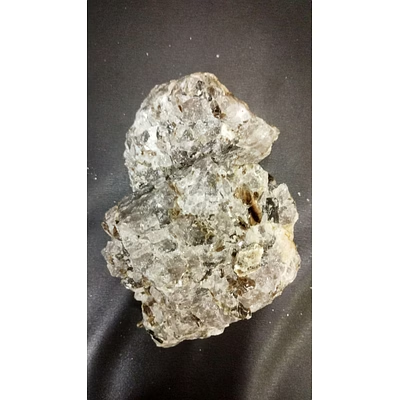
Mica Quartz Lumps for Industrial Processing and Material Supply
mica quartz lumps for ceramics, fillers & refractory use
Ceramics manufacturers and refractory producers source mica quartz lumps for blending into high-temperature formulations and filler mixes. The lumps provide a coarse charge suitable for calcination or further milling to targeted particle sizes. Request current MOQ and lead time to align kiln schedules and batch processing runs.
Material & Size Specifications
- Typical lump size distribution: 10–50 mm fractions suitable for feedstock or primary crushing.
- Bulk density typically 2.6–2.8 g/cm³ dependent on mineral composition.
- LOI (loss on ignition) typically indicative of combined volatile matter, variable by origin.
- Impurity iron oxide traces typically <1% indicative for higher-brightness industrial grades.
Bulk Supply & Logistics Terms
- MOQ: Minimum order quantity depends on fraction sizing and container loading; request current MOQ for project volumes.
- Lead Time: Lead time varies with lump sizing and processing; request current lead time for your batch requirements.
- Supply Capacity: Coordinated with plant-side capacity to fulfil recurring volume commitments and scheduled runs.
- Packaging: Bulk-packed in jumbo bags or loose in containers per buyer preference for processing facilities.
- Quality Check: Material undergoes visual sorting and representative sampling for impurity checks prior to dispatch.
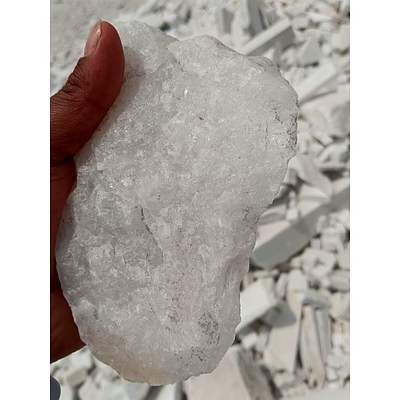
White Quartz Snow lumps for Industrial Processing and Material Supply
white quartz lumps for industrial processing
White quartz lumps are supplied as feedstock for glass, ceramics and foundry applications where coarse high-silica material is required. The lumps are sized for efficient crushing and downstream milling and are suitable for high-temperature processing. Industrial buyers can specify size grading and impurity thresholds at inquiry to ensure compatibility with their milling and melting profiles. Supply is organized into container-load batches with crate or bulk-bag packing depending on destination. Request current MOQ and lead time to align shipments with production runs.
Technical Specifications & Grading — White Quartz Lumps
- SiO2 content typically >95% as per standard industrial-grade quartz feedstock specifications.
- Typical lump size range 20–80 mm for crushing to downstream particle-size targets.
- Bulk density approximately 1.6–1.8 g/cm³ depending on porosity and impurity load.
- Impurity oxides (Fe2O3, Al2O3) typically <0.5% combined; LOI indicative of moisture/organics.
Bulk Supply & Logistics Terms — White Quartz Lumps
- MOQ: Minimum order quantity depends on packing format and destination — request current MOQ for exact volume needs.
- Lead Time: Lead time varies with packing and container availability — request current lead time for your required schedule.
- Supply Capacity: Bulk production scheduled to support repeat industrial feedstock deliveries and planned container loads.
- Packaging: Bulk bags or loose-loaded containers depending on destination and handling requirements.
- Quality Check: Batch sampling for SiO2 assay and impurity testing before dispatch, with COA provided.
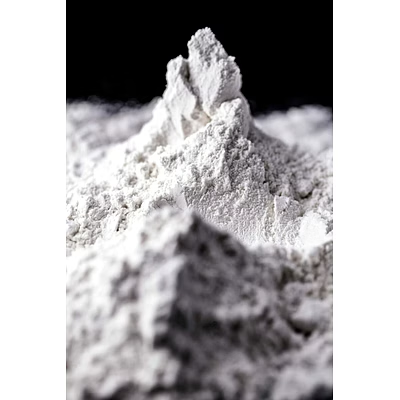
CaCO3 limestone for Industrial Processing and Material Supply
ground calcium carbonate (caCO3) powder for industrial processing
Manufacturers in plastics, paints and paper use ground calcium carbonate (GCC) as a functional filler and performance additive. This CaCO3 limestone powder is offered in controlled mesh sizes and whiteness grades to match formulation requirements. Typical procurement parameters include particle size (D50 microns), CaCO3 purity percentage and moisture content. Buyers should specify mesh size, required purity and packing format to obtain production-fit quotations. Supply capacity supports scheduled repeat orders for industrial compounding.
Technical Specifications & Typical Parameters
- D50 particle size available across micro ranges (for example 2–5 microns for micronized grades).
- CaCO3 purity commonly ≥95% depending on grade and processing route.
- Moisture content typically controlled below 0.5% for stable handling.
- Bulk density and brightness indexes supplied per grade to support formulation calculations.
Bulk Supply & Logistics Terms
- MOQ: Minimum order quantity varies by mesh and packaging — request current MOQ for production volumes.
- Lead Time: Lead times depend on mesh size and batch scheduling — request current lead time for your order.
- Supply Capacity: Factory runs planned to support repeated monthly or quarterly replenishment for manufacturers.
- Packaging: Available in jumbo bags, bulk bags or sealed cartons per buyer requirement.
- Quality Check: Batch testing for particle-size distribution and CaCO3 purity performed prior to dispatch.
Overview
The Industrial Quartz Supplier entry addresses manufacturers and processors sourcing bulk quartz minerals for glass, abrasives and filler applications.
Content focuses on grade selection, contamination control and packaging suited to industrial workflows.
Quartz grades and industrial applications
Select grade by application: grading affects melt behaviour for glass, hardness for abrasives and particle distribution for fillers.
Handling, storage and contamination control
Store in dry, covered areas with dust-control measures to preserve grade integrity and prevent cross-contamination between batches.
- Segregated storage for different grade families
- Use sealed bags or lined containers for hygroscopic grades
Packaging, bulk delivery and contract supply
Packaging ranges from bagged loads to full-container shipments; plan staged deliveries to match processing throughput and reduce storage burden.
Supplier selection criteria for consistency
Evaluate suppliers on batch consistency, documented grade notes and predictable packing practices to support uninterrupted production runs.
Q: What are typical MOQ and pack-size options for industrial quartz?
A: MOQ depends on grade and pack format; common options include 25–50 kg bags or full-container quantities for continuous processing.
Q: How are prices influenced by quartz grade and processing?
A: Higher purity and finer processing increase price; bulk commitments can reduce per-ton costs.
Q: Can batch analysis or material certificates be requested?
A: Batch notes and material descriptions are available to support incoming inspection and process qualification.
Q: What logistics measures reduce contamination during transit?
A: Use sealed liners, secure palletizing and segregated container loading to limit contamination risk.
